World Cup
The World Cup behind the scenes: why 2026 ranks among the most controversial tournaments in history
From propaganda to human rights
Looking back at World Cup history quickly brings you to Italy 1934 and Argentina 1978—tournaments that went far beyond football.
In 1934 Benito Mussolini used the World Cup as a propaganda tool for the fascist regime. The event was meant to showcase Italy’s power and superiority. Stadiums, media and national symbols were fully deployed to give the regime international prestige.
More than forty years later a similar story unfolded in Argentina. While the military junta made thousands of political opponents disappear, the world watched a festive World Cup. The contrast between cheering stadiums and the horror behind the scenes made Argentina 1978 perhaps the most charged tournament ever.
A new kind of controversy
In recent history the nature of the debates shifted.
Brazil 2014 was eclipsed by massive protests against the billions spent on stadiums while large parts of the population demanded better health care, education and public transport.
Russia 2018 turned into a debate over geopolitics and the role of sport as an international showcase for states under fire for human‑rights abuses and foreign conflicts.
Qatar 2022 raised the discussion to a new level. Migrant workers’ conditions, human‑rights concerns, LGBTQ+ rights, corruption allegations surrounding the award and the concept of sports‑washing dominated the global news for years. For many it became a World Cup where the societal debate was at least as big as the football itself.
2026: not one huge scandal, but a pile‑up of issues
The 2026 World Cup will probably not be remembered as the most controversial tournament ever, but as one of the most complex.
For the first time so many different social themes converged at once.
It started before kickoff with questions about U.S. immigration policy. Fans from various countries faced uncertainty over visas and entry to the United States. Human‑rights groups voiced worries about the impact on supporters and participants.
During the tournament the focus repeatedly shifted to FIFA’s relationship with American politics. Close ties between FIFA president Gianni Infantino and President Donald Trump sparked doubts about the governing body’s independence. Alleged political meddling in disciplinary cases also fed the debate.
The most expensive World Cup for fans
Perhaps even more striking was the criticism of commercialization.
Never before had a World Cup been marketed so aggressively as an entertainment product. The introduction of a halftime show for the final, extensive sponsor integrations, commercialized hydration breaks and sky‑high ticket prices sparked worldwide discussion. Final tickets cost thousands of dollars and resale prices hit record levels.
Critics openly asked whether football was still at the centre, or whether the tournament was morphing into a global entertainment platform modeled on the U.S. model.
Technology kept fanning the flames
Even with further VAR expansions and new tech tools, arbitration debates did not disappear.
On the contrary. The broader scope for video interventions sparked fresh arguments about consistency, transparency and whether technology really makes the game fairer.
Climate and logistics
The scale of the tournament also brought new challenges.
With three host nations, sixteen host cities, massive travel distances and matches played during the North‑American summer, the climate impact was front and centre. Hydration breaks became essential in the heat, while environmental groups highlighted the considerable CO₂ emissions of the expanded event.
A mirror of its time
That is precisely where 2026 stands apart from earlier World Cups.
Where Italy 1934 was mainly about fascist propaganda, Argentina 1978 about a military dictatorship and Qatar 2022 about human‑rights and labour conditions, 2026 reflected virtually every major societal debate of today at once.
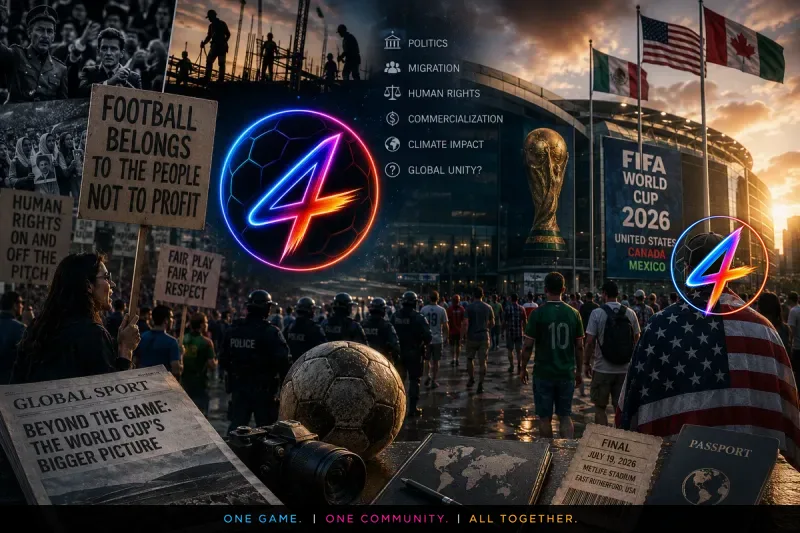
Migration. Political influence. Commercialisation. Technology. Climate. Safety. Global tensions.
Football again provided the stage, but the social context was at least as decisive for how the tournament will be remembered.
History doesn’t repeat, it changes shape
The World Cup has always been more than ninety minutes of football. Each generation mirrors the world in which it is played.
Where past tournaments were used to legitimise political regimes or showcase national power, modern World Cups show how sport has become intertwined with the global economy, technology, international politics and human rights.
Thus the 2026 World Cup will likely be remembered not only as the biggest tournament ever, but also as the edition that made clear how broad the societal significance of football has become. The biggest debates weren’t about who won the title, but about the direction in which global football itself is heading.